

 Apple Podcasts
 Spotify
 Amazon Music
 iHeartRadio
 YouTube
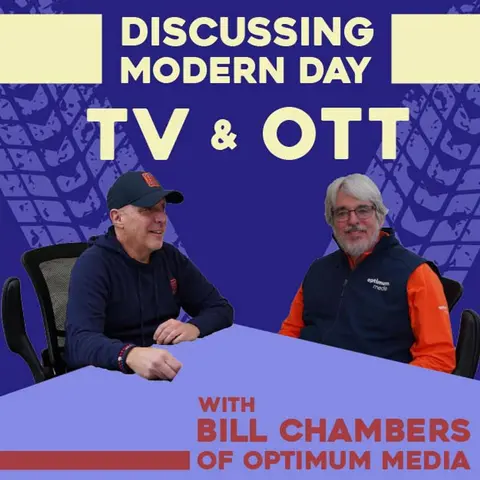
 Episode 16: Discussing Modern Day TV and OTT with Bill Chambers of Optimum Media
Send us Fan Mail Joe sits down with Bill Chambers of Optimum Media to discuss how you can more effectively target your audience and find the RIGHT customers. As media has changed and reaching your targeted audience has Optimum Media has shifted ways to better analyze who your customers are, where they are, and how to zero in on them with effective ad spends that won’t break your budget. Listen in and learn how Optimum can be the perfect partner for your dealership, extending well beyond just ...
Joe sits down with Bill Chambers of Optimum Media to discuss how you can more effectively target your audience and find the RIGHT customers.
As media has changed and reaching your targeted audience has Optimum Media has shifted ways to better analyze who your customers are, where they are, and how to zero in on them with effective ad spends that won’t break your budget. Listen in and learn how Optimum can be the perfect partner for your dealership, extending well beyond just traditional cable television into web and OTT marketing.
Keep listening and remember to like and subscribe. At the Car Guy Simple Podcast we’re committed to helping the Auto Industry as a whole, because when we all do better the industry does better! Car Guy Simple is Powered by PMD! A Full-Service Ad-Agency dedicated solely to automotive advertising.
EPISODE CREDITS:
Produced by PMD
Artwork designed by PMD
Additional music licensed through iStock
Be sure to follow our social media!
Accelerate your dealership success. This is the Car Guy Simple Podcast.
SPEAKER_02Welcome back to Car Guy Simple, the podcast for the retail automobile business. Fixed, variable, anything you could think of. Welcome back. OEMs, you're welcome too. We want to be able to help anybody in need. If you're in the car business, you're in the right place. If this is your first visit to Car Guy Simple, thank you so much. If not, welcome back. Let's continue to build this audience, and we're really, really excited to be back. I guess you can tell that, can't you? We have a special guest uh today. Um, and and uh we've known each other a long time, right? Quite a long time now. So everybody say hi to Bill Chambers from Optimum. And uh it's not the old Optimum, and we're gonna get into that, and we're gonna talk more about what Optimum has evolved into. And it's not a bunch of white-labeled stuff that uh that some of these big boxes do, and we're gonna get into exactly what that means in a few minutes. But uh so welcome, Bill. Thank you very much. It's an honor and a pleasure to be here, actually. Well, well, uh thank you for that. I I I'm just a cog in the wheel, so I appreciate you saying that. And uh we we certainly um we've gotten requests from from people that are uh participants and we and and and otherwise to bring in high-level talent, and you're definitely that category. So thanks for being here. Let's jump right in. Let's go over, in your words, your formal corporate title, what you know, and what are you responsible for? What about your background? What makes you relatable in the car business? Let's start there.
SPEAKER_03Experience. Um, I'm all about partnerships, I'm all about collaboration. As you said, we've got a long history together. Uh, I've been in the local marketplace since 2013, I believe, was when I first came into the New Jersey market. Uh started working with local back in 2010. But overall, I've been in the industry for 35 years. That's a good start. So you're rookies, good. Yeah, the rookie. Yeah, a little bit of experience. The gray hair and the lines on my face. When I look in the mirror every day, when I wake up, I'm like, man, I am old. Um, but the beautiful thing about this industry and what keeps me so jazzed and why I love it so much is because it's constantly evolving. Like the more things change, the more they stay the same. Right. So there are a lot of underlying similarities, but I've seen so much change in this industry. I was a part of the first disruption of television viewing, and now we're just going through the next iteration thanks to technology.
SPEAKER_02Well, how far back do you go? Do you rabbit ear guy? Did you I mean the original cable box that had a chord and push buttons for the channel?
SPEAKER_03And you used to have to switch it up and down. Yeah. Switch up for the top level and then switch it down to the next level.
SPEAKER_02It's a formal corporate title.
SPEAKER_03It's some long thing that doesn't fit up desk black, right? Currently, I am senior director of team BSI, Business Strategy and Insights. Um, I actually modeled the name after the TV show CSI, Crime Scene Investigators, because it seems like there's so much chaos and fragmentation occurring in this industry, right? Especially when you start talking about local markets.
SPEAKER_02So you invented your own title. I did. And and why such a long title? Does it encompass everything that you're responsible for, or does that allow you to get involved in development of things? Both? Where does that land? All of the above.
SPEAKER_03It's all about strategy and insights. Uh I kind of earned a reputation in the New Jersey market as being the myth buster. Um, I would come up with all of these great things with my management team, Rich Kicks, Michael Bartoli, Barry Martin, and and we would talk about different ways to take all the knowledge and things that I gathered to the market. So we would develop like learning events. But this doesn't apply to people that have a Ford dealership in Muscle Shoals, Alabama, does it? Uh, it applies to anyone.
SPEAKER_02Well, you're a drummer, right? I am. Who is the band? Josh, you're you're uh on on mic with us, right? He already knows this, right? I'm on mic. Okay, don't tell. What is the band most famous for their recording studio in Muscle Shoals, Alabama?
unknownMuscle Shoals.
SPEAKER_02Rock band.
unknownI don't know.
SPEAKER_03Started with an L. What? Led Zeppelin? No. Starts with an L? No. I don't know. Leonard. Leonard Skinner.
SPEAKER_02Letter it is. Ding, ding, ding, ding, ding. Final answer. You win. So are we going to talk about stuff that could be plug and play anywhere in the country? Well, thanks to technology, the answer to that now is yes. Okay, so so we're not here to talk about cable television and get what your local cable rep. We're we we've expanded.
SPEAKER_03Yeah. Well, it's one of the biggest challenges we have is we're not the artists formerly known as cable vision anymore. We are a pipeline. Do you have a symbol? Uh yeah. That's right. Yeah. Optima Media. Got it. It's all about media. Cool. Consumers engage with media so many different ways thanks to technology. I was saying before, the more things change, technology is the main driver of change. Okay. It creates easy access to all forms of entertainment today.
SPEAKER_02So the Chinese said thousands of years ago, the journey of a thousand miles starts with a single step. So can we start at that single step? Right. We were kidding around before about the cable box thing. Right. Let's start there and then let's build on that foundation and talk about what else you guys are involved in and and why you brought it to market and what it means. And and because because you're that you're that astronomer. I I've known you a long time. You're the person that there's I've seen you in meetings. You're listening actively and you're looking at the ceiling and you're moving it around in your head and you're like, yeah, but if what about a pony? And like it's it really works good, right? So so so what makes two it's a two-parter kind of one answer. Why should dealers engage with optimum? And what makes them engage and stay with you? What sticks? Because it's more than cable, and we're gonna get into that.
SPEAKER_03Yeah. It's all for me, it's all about strategy. I I started off as a sales assistant at a television rep firm, and that's when I learned the business. And if I had a dollar for every person that came up to me and said, Oh, you've got a bright future in sales, then it's one of the songs we do in our band, right? Bright future in sales. Uh so what back in the day, I used to have to, they wanted you to learn research. What is a reach? What is a frequency? What is a rating? And this is we're talking 1990, it was a different world then, but this is when cable first started gaining momentum. So I learned. I learned how to work with salespeople and support salespeople, and I found that to be my niche, right? Right, is is helping and supporting sales with data, right? Data-driven insights, not just taking the data for face value, but crafting a story behind it that people can relate to, resonate with, and make it understandable. So there's the defining difference.
SPEAKER_02When we started our uh our ad agency, that was the paid political announcement, PMD USA.com, powered, powering this pod. But when when we first started, most cable reps, regardless of where if it was Jersey, Florida, out west, it didn't matter. Everybody wanted to quick, fast, and easy, right? Cheap, fast and easy. We'll just put an ROS schedule Monday through Sunday,$3 a spot. This is going to work really well. And we we remember we took the broomstick and shoved it in the spokes as an ad agency that said, nay, nay, we want to work with reach and frequency because we know how to sell cars and cable television sold cars. That's right. But nobody watches cable anymore, right? Uh that's the mystique. Yeah. Can you want you want to dispel that one before we go on? Briefly, is cable dead?
SPEAKER_03Cable is so not dead. Why? Um it's just shifting. It well, first and foremost, especially in this market, penetrations are still high. I mean, where else can you get over 40% of an audience that you can as close to guarantee the delivery of that message in a specific zone, if you will, right? In a world of programmatic and guessing, we hear it all the time. How come I can't see my spot when I'm streaming?
SPEAKER_02Does that work in Iowa as well and Arkansas as well? And the recording studio for Leonard Skinner? Absolutely.
SPEAKER_03It's it's a great equalizer. Digital has become the beautiful thing about people migrating towards watching television via streaming now is you're not constrained to those zones anymore, those specific predefined footprints. The value that cable had back in the day is that you didn't have to buy broadcast and reach areas that were not relevant to your PMAs, right? Your backyard. Right. Cable helped to kind of make it a little bit smaller. Now, today, with streaming, you can get pinpoint down to the household again if you have the right infrastructure. Well, so let's let's let's compare the two, right?
SPEAKER_02On Swin Lane, we have a very structured cable zone, do business with that cable company, right? And then we have this this fancy term that somebody smarter than me came up with a bunch of years ago, cord cutters. People are like, I'm not, I don't need a box anymore, and I'm gonna stream my my television. And somebody decided not to call it television. They decided to name it over the top OTT, which I still don't understand that name, but they decided to make it a digital play. Now, in our world, in PMD, when we work with clients, we don't discuss OTT as digital product. It's a sure, it's delivered through a digital and ISP. At the end of the day, though, it appears on your television. So we consider this an alternative to cable. It's a digital feed for television. Would you agree with that? That is correct. However, you're going really squirrel hunting with an elephant gun because if you excuse the expression, but it's really what it is. Because with OTT, if you understand the market and you understand the data, as my friend David always says, and in God We Trust, all others bring data, right? The data drives the decisions and can not only complement cable, but fill in the blanks of a percentage of the audience within given zip codes that makes sense to attract buyers to either stay loyal or consider that store on their list of stores to shop. Would you agree with that? Absolutely.
SPEAKER_03It's all about filling in the gaps. You have a foundation of trust that still today is your traditional or what we used to call linear, right? Now it's traditional television going to a channel position. What's migrating is now, thanks to technology, you don't go to a channel position, you go to an app. And you have so an infinite amount of choices, it seems like many of them are duplicative.
SPEAKER_02Everybody wants to talk. Now they change it, right? Now everybody's CTI and we want to do all this other fancy names. We want to do it's over the top. It's it's it's a it's a cherry-picked group of zip codes, right? Yeah. And I mean, you know how we do it. We have some zip codes, we for a client will have one message, different zip codes, we have a different message, and the metrics matter, and we hate map the store, and we understand where the low-hanging fruit is, and then we go and we hammer that and it makes sense. Cost per point works still in the OTT world?
SPEAKER_03No, it's now becoming a CPM cost per thousand. Why is that? And I know that, but that's pay red, ready, ready?
SPEAKER_02Listen to this one in case you didn't know, or a refresher. Go, Bill.
SPEAKER_03Basically, a rating point is a percentage of a viewing audience against a viewing population. Say that again. It is a percentage of a viewing audience relative to a viewing geography, and you divide the two into each other, and that's a percentage. That's your rating. Why? Why does that matter? Why does that matter? Because it's a certain percent of a viewing audience. You know, if you're buying it, you want to see where the engagement is. You would tell me all the time if you missed a spot, how many potential car sales did you miss because that spot didn't air? Well, we know the answer to that. Well, there you go.
SPEAKER_02And that's why our make good schedule is as your cable brethren would say, is very punitive because when we all sign off on a month's budget for a store, there's no carryovers, there's no oopsies. We believe that if we have it aligned properly, we played the data out properly, we understand who we're aiming at, the reach and frequency, right? Out of 100% of an audience, what percent really needs to be reached, and how many times in that given month, if we do that all properly and everybody's great, it's but it's not set it and forget it. Because if we blow the mission and it all doesn't air, would we lose the opportunity to get people to consider coming to that store? The answer is yes. Absolutely.
SPEAKER_03It's all about exposure. And and and to be honest, I mean, uh, a rating is uh, you know, back in the day when Nielsen was the sole currency, and now that's even that's changing, right? There are other companies like ComScore that are coming out there and getting into the measurement game. There are many others uh behind them as well that are vying for a piece of the pie, if you will, because there is so much fragmentation out there. No, that's technology drives that. Um, back in the day it was simple. You had one measurement system with their sample in place, right? They would gather the amount and they would take that number, divide it against a specific geography locally, and that's how you got your rating. But today, boundaries are the walls are coming down. To your point before, we're not just Larry the cable guy, we're a pipeline. I don't even have a fish hook in my hat, so I don't qualify. Right. So you can stream content anywhere, and that's an impression, that's a view. And there are no predefined geographies anymore because people can access anything anywhere. So that's why it's really starting to migrate to more towards a cost per reaching a thousand people as opposed to a percentage of a certain specific geographic area.
SPEAKER_02Can I ask you a zeroed-in point blank question that that somebody watching and or listening, and thank you again, tell your friends, this podcast, Car Guy Simple, from a television perspective, whether it's cable or OTT, let's just narrow the field of offerings, right? If you had to pick the number one thing, what is what's the leading strategy to conquer a rooftop market? How does that fit into this conversation within the confines, within the four corners of OTT and cable television?
SPEAKER_03To start, it's analyzing the data and the challenges. Our job is to help you solve a problem. Okay. How is your market share going? How are you competing against other dealers in your PMA? Once we have those analyses in place, we try to strategically meet and show. Uh, we just had an example before where you know a certain brand was down and and we took a look at how they were performing against the entire region. They were down 5%, but the entire region was down 20%. You're holding share there. That's an insight that shows what you're doing is bucking the trend, if you will.
SPEAKER_02Do you allow agencies to just set it and forget it, or do you counsel with them and the end user, the dealership in question, or dealership group? How far is your your tentacles real short, or are you willing to say, hey, you need to be aware of this? Yeah, we play with our partners, uh, just like the relationship we have with you.
SPEAKER_03What do you play with our partners? Like dodgeball? Well, yeah, absolutely. We engage, we we come up with strategies. Listen, you are representative of dealerships, right? So when we come and we speak to you, we're gonna come to you with our insights and our plan and have a strategic conversation. And then that opens the door to so many other things.
SPEAKER_02Because to us, there's three types of groups. There's groups of agencies that are very data driven that that make decisions based on a number of things, not just go, ah, we got money. And then there's agencies out there that are not as data driven, and then there's direct billing. Is there a difference between the direct billing conversations where it's the dealer or dealer group versus the knowledgeable data-driven agency, or is it similar? Is it different?
SPEAKER_03I I I think it's different in its approach because if you're more than willing to have that conversation to dive in, we're not about setting it if you get it. Okay, right? We we are all about growth. Our job is growth? Your growth, your dealers, your auto dealers to the end users' growth. The end users' growth, our clients. What are your goal? Generating leads, qualified leads. That's our focus to get more qualified leads to visit your dealer's website, your vehicle display page, showing up to your dealership. That's our job.
SPEAKER_02So we're gonna talk about that after the break, and we're gonna get in into a discussion because you know, we're a group in an advertising agency of car people that happen to be in the media business versus media salespeople trying to sell a bunch of stuff to car people and don't have any tie back to that. And and that's where the conundrum goes because a lot of a lot of companies are out there pushing goods and services that are tonnage-based, that have a that have a very low conversion to showroom traffic. And tonnage is a waste of time, money, and effort. Would you agree? I agree. All right. So, last question before the break. If you had to well, can you? Let's compare OTT to cable, right? Okay. Would you ever choose one over another? Is there any scenario or a couple of different scenarios in a short little couple of sentences that you would pick one over the other, or is it a blending based on what the data says? How do you approach that?
SPEAKER_03The latter. Uh, I'm all about uh I was a Saturday morning cartoon kid. And if you remember schoolhouse rock, I'm all about conjunction, junction, what's your function? It's not this or that, it's this and that. Television has morphed into both. There are still people that watch traditional, myself included, my kids included. I have kids, you know, 26, 22, 21. They still engage in both. Yes, they spend a lot of time scrolling and doing, but more times than not, when they want to be engaged with us and they want to watch their shows, they're watching it on cable, traditional, linear, whatever you want to call it. But I think it's a mix of both. Traditional establishes a foundation. First and foremost, just from an inventory standpoint, it's more plentiful. There are more ad breaks in traditional than there are in streaming. And we get allocated a certain percentage of that opportunity to insert our clients' commercials in this great premium content. You know, you asked me earlier about live television, it is dead. This winter has been rough, right? The weather has been brutal. The ratings for News 12 have been absolutely phenomenal. And the reason why is because people know it's there. Now, on average, is it what it was? Maybe not. People are fragmented. They get the truth of the matter is we're seeing huge growth on other screens. They're not getting it on news12.com or they're streaming it on a News 12 New York, for example. But in times of trouble and when you need that trusted, they're hitting the network and we're seeing it on our own data. Then Mother Mary comforts me as the song goes, right? I had to do it to you. Yeah, I had to do it. Of course, right? In times of trouble. And that's the foundation, trust. I mean, right when you're buying a vehicle, that's a high purchase price these days, right? Especially everything that's involved. Okay. You you you establish that trust, and then the OTT portion, it's like you said, it fills in the gaps. It gives you the ability to sharpen that pencil, to fine-tune specific targets, to append all different types of data, which I know we're going to talk about later, but we are. We are using it.
SPEAKER_02And I'm going to break down on some of that, right? Because the folks that that are that are listening, watching, again, thank you. We we really, really, really want to get into some finer points in this one. And we're going to break in a second or a couple seconds. And when we come back, you know, let's hear more about what else you're doing other than television, why it's relevant, how to measure success, how not to just look at a tonnage report and go, we're not selling enough cars and you got 6,000 leads, and what are you thinking? Right. You can help us extrapolate out the nuggets. And also, I'm going to pin you down important things to ask your current providers that are relevant to the products that that you're involved in. Not to outsell somebody, but let's give our audience some things to be able to analyze because right now business is money is painful to spend, even in good times, right? So let's take a break and we'll go there. We'll be right back. Thank you. Great.
SPEAKER_01Our full service ad agency specializes in providing creative solutions for new car dealerships looking to sell more vehicles, increase service numbers, and promote their brand image more effectively. We use our experience in television, OTT, digital, social media, and more to anticipate challenges and find effective market-dominating solutions so that our dealership partners can thrive in an ever-changing landscape. You can learn more at pmdusa.com.
SPEAKER_02Welcome back. Welcome back, and thank you for staying uh on this pod, this particular episode, and every other one that you've been kind enough to uh be an active participant because listening is a skill and that's participating. Today, Bill Chambers from Optimum, thank you with that wonderful title that you came up with. And we talked about the stuff that most people are familiar with, right? Cable and OTT. Can we do it? Can we bank hard right? Sure, right? Because NASCAR is always left turn, left turn, left turn. I'm gonna go hard right. Let's do a little Grand Prix here, right? Change it up a little bit. There's other things that that your company does that you're not just licensing, that's your product, that you have think tanks and you oversee all those think tanks, right? Well, yeah, a lot of things. The think tanks, the data, the the strategies, and the distribution. Cool. Where do you want to start? What do you what what what's the next thing? What's the next not the next best thing, the next greatest thing? What thing do you want to talk about next?
SPEAKER_03One of the things that I am most proud of what my team does is we truly are consultative. We're consultative where we're leveraging data that's relevant to our clients. So speaking of automotive registration data, sales data in your PMA, how are you performing not only in what was our cable footprint and is still very important as a foundation, but to be able to, as more and more people migrate towards streaming their content on their connected TVs or on all devices, which is OTT over the top. It's not just the connected TV, it's the mobile devices and everything else. To expand beyond those footprints, we can go anywhere now, anywhere in the country, any zip code, any county, any state, any DMA, if you will. So, Josh, can I get a TV timeout, please?
SPEAKER_02TV timeout. Thanks. So so that's that's that's what a deck is for. You get all this data. What products other than cable and OTT are you gonna use to blow that data up and make it even better for a dealer group or a single rooftop store? Let's start with one of them. Give me a product. It's the exhale product, it's video. No, I'm kidding.
SPEAKER_03It's it's it's video. It's to me that there's no greater way to the videos that you create, your message, your advertising commercial, whether it's 10 seconds, 15 seconds, so it's a TikTok video of the guy on the showroom floor pretending he's rowing across the showroom floor and ha ha ha ha, funny, we're gonna sell cars.
SPEAKER_02Or is it what other like programmatic?
SPEAKER_03What kind of video? What do you mean? Video that engages a consumer. So outside of our world, yes, we get into production, we can create different things, we can have different scripts. To me, one of the most important things that we talk about is the importance of messaging, having a message that's gonna resonate with a consumer. And there are many different ways to do that. You could do it in a comedic way, a funny way, a serious way, impactful. Um, you know, it's telling your story that's gonna resonate because most people are not transactional. They're relational. 95.5, right? 95.
SPEAKER_02What do you think sells more cars? Price point, transactional, or value-based propositions that get people to willing to listen to how much?
SPEAKER_03Which do you think drives traffic in today's world? I I honestly think it's a combination of the situation that the person is in. Some people are loyalists, they love the service, they love the convention.
SPEAKER_02So, other than video, do you have digital services that help drive these messages?
SPEAKER_03Well, absolutely. Digital is is the is the uh the pipeline of messaging. We can deliver video, we can just deliver display ads, we can deliver display ads that scroll. I mean, there are so many different ways to message to somebody digitally and all the different screen sizes and devices that are out there.
SPEAKER_02What's the number one device, in your opinion, that is used today by the mainstream vehicle buyer, driver, whatever the right phrase is? What's in your opinion, in your opinion, what is the number one device that people pay attention to? The television screen.
SPEAKER_03We not a phone. No. The television screen is the most trusted device. Now that's not time spent. We're talking about trust, engagement, right? Resonance. When you're locked in, okay, you have your attention is on that 60, 70, and now today, right? The size of the screens, the prices of televisions have come down, all the apps are built into that today. When you want that engagement and that experience to me, that is still today the most trusted device. Why are people watching World Cup on their PDA? It's it's multitasking. I I watch my sports on my phone when my wife is watching Dancing with the Stars on the big screen. Sometimes we multitask, right? If or they will go to another room where they have their own TV. That's fair. I mean, I think, listen, we live in a multi-touch, right? Most people multitask. I think the latest that I saw 90% of people watch television with a second screen in their hand. My wife does it with three of them. She's got her iPad, her phone, and the television screen. But it's the content, it's that trust. And you know me, I'm the data guy. I take a lot of surveys from many different credible companies where it's it's consistent. The most trusted advertising vehicle today is television. Television has changed, how they get that content. Sports, news, entertainment, genres, it's as healthy as it's ever been.
SPEAKER_02Is does one size fit all based on franchise, or do you feel that a blended mix that that that appeals to that particular buying demo for that specific OEM is what needs to be really thought about when you look at data and you break it down as to what to present with that dealership's name and claim?
SPEAKER_03Oh, it's definitely a multi-tech uh multi-pronged approach. I mean, we talk about the marketing funnel. Sure, right? Marketing funnel still exists. Everybody's trying to change it. It doesn't exist. They change the shape, the colors. The truth of the matter is, each section of the funnel now has its own little mini funnel within it. And again, that's where leveraging data, deterministic data, real data, sales data to look for an opportunity. Where are you falling short? Where can you conquest? What zip codes are you maybe falling a little short? And losing market share over a period of time. How can we strategically then saturate that market with your message to get that consumer to choose you as the reason why they need to go there?
SPEAKER_02Okay, so let's let's zero in on this funnel thing, right? Right? It's been around a long time, right? In the bottom of the funnel, or are our intenders that are in the market now? Yeah. Right. Everybody migrates towards that. And and as business gets softer, weaker, dollars are thinner to spend. I mean, when I was a Chevy dealer, I had really good times, and I was like, let's go higher up the funnel. And then when things were on the tight side or inventory was a problem, oh, let's go to the bottom of the funnel. I just want to know this month. What's your position? Do you want to work higher up the funnel whenever possible when budget allows? If yes, why?
SPEAKER_03You want to do it because you want to create that awareness, that mass reach. You know, you said before about the carpet prom approach. It is very difficult today because there isn't that one environment like back in the day, I love Lucy had a 70 rating, right? Right. Outside of the Super Bowl, you're not getting those events anymore. Everything is so fragmented. So that's why understanding what problem can we help you solve with the insights that matter the most to you. So again, talking automotive, it's all about sales, right? Registrations. How many sales am I getting in my PMA and in surrounding areas, taking a look at the competition? That's what my team, I mean, I say it's it's me, it's not, it's my team. I I have a an automotive expect uh expert that you very well know. Um, she loves automotive. It's her passion. She loves the data, she loves analyzing the trends, and she's been a game changer for us because we do have the distribution, we're a pipeline. And thanks to not just our ownership, but partnerships that we've invested in to have access to virtually every platform that people are engaging with.
SPEAKER_02In your opinion, is there a correlation between various places in within the purchase funnel and budget spend or is it just spend the money and and land it as a total package? Do you think there's specific percentages of a budget that should land in various thoughts, thought processes that a consumer goes through before they make that final I'll take the blue one?
SPEAKER_03Absolutely. As a matter of fact, it's one of the things that my team studies. Uh, we talk about the the long and the short of it, right? Uh it was a study that was done by uh Mark Rits and announced it, but it was Les Bonnet and Peter Fields that came up where they analyzed over a thousand different businesses and categories, and they found the ones that succeed the most have a balance. That balance is 6040. Now, yes, specific industries are going to change. More, you may have more on the 90-10 side, you may have more the inverse, 30-70. Understanding the nuances and the challenges that our clients are facing, our job is to roll up our sleeves, ask some of the questions about budget. What are you spending? We we we have ways of uncovering sometimes people uh focus an inordinate amount at the bottom of the funnel, and we're not telling you not to do that, but you're overspending on it.
SPEAKER_02That's like a direct mail piece. Just chuck it in here and immediate gratification.
SPEAKER_03But but thanks to data and pipelines and the way streaming works now, you don't have to just mass, you can be targeted. Okay. It's not just it's the approach of advertising where it matters most.
SPEAKER_02So now can I take this this? And this is I I I mean, you are a wealth of knowledge, and I I just scratched it. I would surf my hat off to you and show you my bald head, but you've seen it enough times. So, so I love to ask this uh this next one. It's one of our favorite things to do because with with our with our advert agency clients, we want to to educate them so that they're asking the questions of us before we have to pull the studio audience and pull it out of them, right? So so when somebody's done with this pod and they're they're thinking about their budget spend and and the things that they're spending it on, right? How do you and and take your time on this explanation? This is not a two-sentence answer, right? Um how can a client properly analyze the effectiveness of their campaigns? Because you just laid out all this great stuff, and still there's a lot of the people they, well, if you say so, how do we get rid of if you say so and let them come back with? I did my analysis. Now let me ask you critical questions. So, how can a client properly analyze the effectiveness effectiveness, easy for me to say, the effectiveness of their campaigns?
SPEAKER_03It's a great question. Well, I think we try to get people away from what we like to affectionately call vanity metrics. What does that mean? Vanity metrics, clicks, likes. I know the person clicked and came, and that's the reason why. What they don't understand is the process that the consumer took to get there.
SPEAKER_02I feel like I feel like remember Hulk Hogan, may you rest in peace, and he'd be in the ring and he would do the motion thing, he'd leave and he'd wave his hand. What did he just say?
SPEAKER_03Can you break that? Break it down, break it down a little bit more, weeky, week, weeky. The results that matter, the three things that we try to tell people to look at, especially if they're using Google Analytics, is take a look at your direct search results increase. How many people are typing your name in as opposed to best deal near me? You that's a rat race. Everybody's bidding on those keywords and and piling on.
SPEAKER_02But don't you find that that big box GA4 laminated into the month report lagging indicator, which means absolutely nothing, and they they cling on cling on, not the the television. They cling to the data, look how many clicks of tonnage. Right, we're back to tonnage again, right? Versus, you know, we want that three-minute time on site. We want a minimum of three pages. We want the rule of threes, right? How does, how do you what can what give us give us however many you want, take your time of things that somebody can say, wait a minute, this is a better way for me to do my own research and then have quality conversations between myself and the people that are selling me the stuff that's supposed to be putting people in my showroom. What do they want to know?
SPEAKER_03It's it's comparing and contrasting. What were your analytics before versus during and after? We we talked about this before. You never want to be with somebody who's gonna set it and forget it. We're not an algorithm, we're not just clack there. I don't know what you're doing. Constantly trying to evaluate trends, patterns, right? Reach builds over time, right? Once your reach starts to plateau, now you need to build frequency. If you see something one, two, three times, once you write to that fourth, fifth, sixth time, it's like ROI. For every dollar you spend, how many do you want back? Nobody's getting out of bed for two to one, three to one. But you can't be in and out on every other month.
SPEAKER_02Is it a consistent? I know everybody likes to talk about consistency in cable. How about the rest of all of what we're talking about here? The the bouncy nature of in and out, does it damage these metrics in your opinion?
SPEAKER_03You need consistency. Why? Absolutely. Because it's a like I said, once you get to that reach and you build that frequency, then you know you have a presence. And that's where you can start really diving into your analytics. Did I get more lift? Have I seen more ups in my showroom? Have I gotten more direct requests or visits to a specific page because that was being advertised? Tier one is a great hype machine. They spend millions, if not billions, of dollars on television to promote their brand. Uh, I remember we had a conference a couple of years ago. Uh, Jim Appleton at the time was running, and and we asked him the question what would you like to see more from your local, your tier three guys? And he said what he said really resonated with me. And it goes back to what I was saying earlier about messaging, to be able to promote the value that the local dealer brings to their PMA, to their town, to their county. What is the value that that dealership brings? Yes, it's great to have the sizzle of the vehicle and the beauty and the honor, but how are you driving that person once they're engaged and they're interested, right? You made them aware they're interested, they're going to consider you down to loyalty. Okay. How are you promoting yourself? And I think that's something that really does resonate. Getting that message out, saturating it on all screens in a variety of ways for all different targets, analyze the data, look how it's coming in, and then give us that homework. Our job is to find those audiences, deliver that reach and frequency, be able to build upon it, and then come to you and help you open the book and say, you know what? It's not a matter of giving us credit. It's a matter of, wow, this is a great partnership. You're helping me by saturating my message, and I'm seeing the results in a variety of ways, whether it's through web visits, web traffic specifically, getting that consumer to search and type your name in, and then ultimately making the sale. Those are all great thoughts, and I agree with you.
SPEAKER_02And now I have because we're running a little short on time here. So I'm trying to get 10 pounds in a five-pound truck right now because I could sit here for another 47 days and we can continue going marathon central. Okay. So let's um are you are you a football fan? Absolutely. And and your college team that you root for is the you, right? Because it's all about the you. Am I right? We do this with every five year comes on the air, we talk about the you. You're familiar with football programs, whether it's college or pros, right? Right. Absolutely. And there's different rooms. There's the quarterback room, the receiver room, and the the line room, and this room. There's all these different special teams. There's these different rooms, right? This is great, right? It's not just one film room, right? Yeah. Why is it, if we could use that as an analogy and benchmark that, why is it then that most dealers and their team are guided? The Sherpa is the one film room. It's the GA4. What about the CRM? What about traffic logs? What about all the how do you feel just the GA4 is good? Or do you want to spread it out and look at all data? That's the report card. What is the GA4, if you will?
SPEAKER_03If if the dealer is you, uh we hear it all. Is that more past file than A through F, though? Yeah, well, it's it's well, I would not like it to be, but that's unfortunately the world we live in today. Uh right. So what we try to do is utilize all of those things. And we, you know, CRMs and data. Oh, I can we talk about this all day long. And again, one of the reasons why I am where I am is because of the amount of robust deterministic first-party data that we sit on, not just the hundreds of thousands of boxes. So we know contextually people watching, compare that to other sample-based projected estimates. So you like we have deterministic data.
SPEAKER_02You like all these rooms.
SPEAKER_03Well, let's but yes or no, do you like all these rooms?
SPEAKER_02Go okay, I'm going to go. I love the rooms, but why is it that one only focuses on that? I got a better one for you, because you just you just gave it to me. And so thank you. You went exactly where I wanted you to go. You like all these individual rooms? And then the and then the group room, which in this case would be the GA4. Well, do you have a problem with wide receivers also paying attention to the quarterback room and special teams? Absolutely. Getting on the same page. So I'm going to give you a chance to do that.
SPEAKER_03So don't be a one-trick pony, is what you're saying? Never want to be a one-trick pony. Again, conjunction junction. Not this or that. It's this and that, right? To be consistent there. But here's a better one. So my teammate, a gentleman by the name of Tom Parsons, brilliant strategist, been in the industry for 25 years. He just recently wrote a book that has become rapidly a bestseller. It's called Lead or Bleed. And it's a book that was written to help marketers understand everything that we've been talking about, not focusing on. Who wrote the book?
SPEAKER_02Say it again. His name is Tom Parsons. Tom Parsons with a P. Yes.
SPEAKER_03And what's the name of the book? Uh Lead or Bleed. Buy it. Go ahead. Buy it. There you go. He, in one of the sections of the book, he talks about we're talking about football. Are you familiar with the tush push?
SPEAKER_02I've seen it. I'm not exactly a fan of that because Miami doesn't use that play in Hurricanes football. But go ahead. The city of brotherly shove. Well, there's green in their uniform, so it's close. Josh, that's close enough, right? Green in the uniform?
SPEAKER_03I believe blue. Okay. Oh. I will ask you the analogy. If a team, if you look at the stats, it's got an incredible success rate. Oh, he scores a touchdown. The success rate on converting fourth down to first down. Okay. But if that team implemented the tush push on every play, would they be successful? No, they wouldn't. Well, you need an offense, you need a passing game, you need a quarterback that can throw, you need receivers that can run their roots, you need guys that can block up front. They never get the glory.
SPEAKER_02That's how I used to drill my uh drill my son or screw him right into the ceiling. When he was a little guy and he was a very accomplished lacrosse athlete, he had 19 schools on him to play in college, and he had a great high school and college career. When he was a little guy and we played Madden football, all the buttons. I didn't know what buttons. So four downs, I never punted. I played four verticals. I just it that's what I played. And he used to get so mad at me. And more often than not, I kind of was successful, but I didn't know why. How does that differ from what you're proposing here?
SPEAKER_03Well, because we don't get into the war room on the blocking schemes, the lifting of the weights, the guys that are clearing the way to help that team march forward, or on the conversely, to stop that team working hard on defense. All the unglorious positions, if you will. Why is the quarterback take their offensive linemen out and buy them Mercedes or everyone? This is where the collaboration comes into play. Tom does a great analogy in this chapter in his book, talking about the Tush push, because that's what everybody focuses on, the last click attrition, or it's this play, so that's what I need to do because that's what scores the touchdown. Okay. You need to pay attention to all the facets of the game.
SPEAKER_02So we're running short of time. I have two quick questions for you. We'll keep it short answer, right? So there's rapid fire. Are you ready for the first one? Yes. Did you walk to school or carry your lunch? Only kidding. Let's start with the first one, right? The first one is is to me a very simple thing. Uh why just why not just go direct? Why, why does an agency like PMD still deserve to be in business? Is collaborative better, or should they just be vertical and and linear and just go to you?
SPEAKER_03Collaboration is always better. Why? Uh it's just the ability to share ideas, bounce ideas off of each other, develop a strategy. There are so many different nuances of things.
SPEAKER_02And thank you for that. It's it's not a paid political announcement. It's not. So the final person. This is the final one of the day, right? And and thank you because you you it's like we're telepathic. You keep you're you're you're we're on the same wavelength, right? So based on that answer look at the camera, your camera, and tell our audience what are the things when they stop listening to this pod, which is gonna end in about what two minutes-ish, Josh? Let's let them rep. Okay. What are the what what is the takeaway? What do they need to think about? What not 79 things. What are the what are the things they need to think about?
SPEAKER_03Ready to go. Reaching audiences in the most accurate, effective, and efficient ways. Leveraging partners that are gonna come to you and ask questions about your growth. You want to avoid the person that comes in. I now have Netflix, I can get you on this, I can do that. No, how can I help you overcome a potential challenge? My team thrives at doing the pre-CNA. We work with our sales teams. We want them to be consultants and ask the questions that are solely focused on our customers' growth. How's your market share? Where can you see improvements? Let's drill down to specifics of codes because we're not held to the geographies of the past anymore. We have partnerships that help us to get your message in front of as many people in the most accurate, effective, and efficient ways, but we're not gonna set it and forget it. We're gonna leverage your insights, your data, selling ships. That's what to look at.
SPEAKER_02Listen, what do they need to think about?
SPEAKER_03Thinking about strategy, consultancy and growth.
SPEAKER_02There it is. So collaborative data thoughts.
SPEAKER_03Trust the data.
SPEAKER_02Optimum is anywhere in North America because you have the data, the insight, the knowledge and the expertise to get more vehicles over the curb.
SPEAKER_03That is correct.
SPEAKER_02And the last I actually I fibb. There's one last question. What's it all about, Bill? It's all about the customer. No, I'm holding it up, Bill. Don't let me tell you. It's all about the only letter in the alphabet. It's like Cesar, the U. The U. That's right. There you go. Bill, thank you so much. Bill Chambers, everybody, pay attention to this guy. Rewind this thing and listen to it again. We're would you come back?
SPEAKER_03Uh uh, listen, there's so much deeper we could get into. There's so much to talk about. You would love to come back. I would be honored 100%.
SPEAKER_02Anytime you want, man. We're we you know, we can devote more specific episodes to the to the way.
SPEAKER_03The way you know whatever you need, I'm here for you. You know that.
SPEAKER_02And that brings us to a close. How fast was that? I can't believe it. Like, I'm I'm still like, what happened? It's a blur. Thank you, Bill Chambers from Optimum, for being here. We really appreciate you. We really do appreciate you. And we also appreciate everybody that's subscribing and listening. Don't be shy. Tell your friends there's more coming your way on a regular basis. We've got episodes at this level of horsepower that's gonna get you to turn it off and think to yourself, huh? Be your own astronomer. Ask the hard questions and be willing to accept the answers that may not fit your narrative but get you to think a little bit more. Let's deliver more cars, let's get them over the curb. Joe Levine for CarGuys Simple, CarGuysImple.com. See you real soon and thanks very much.
SPEAKER_01Follow us on Instagram, Facebook, LinkedIn, YouTube, and at CarGuysimple.com to learn more and see behind the scenes action. If you have a topic you want us to discuss, we'd love to hear from you. Feel free to send Joe an email at Joe at CarGuysIple.com. This is the Car Guy Simple Podcast. See you next time.